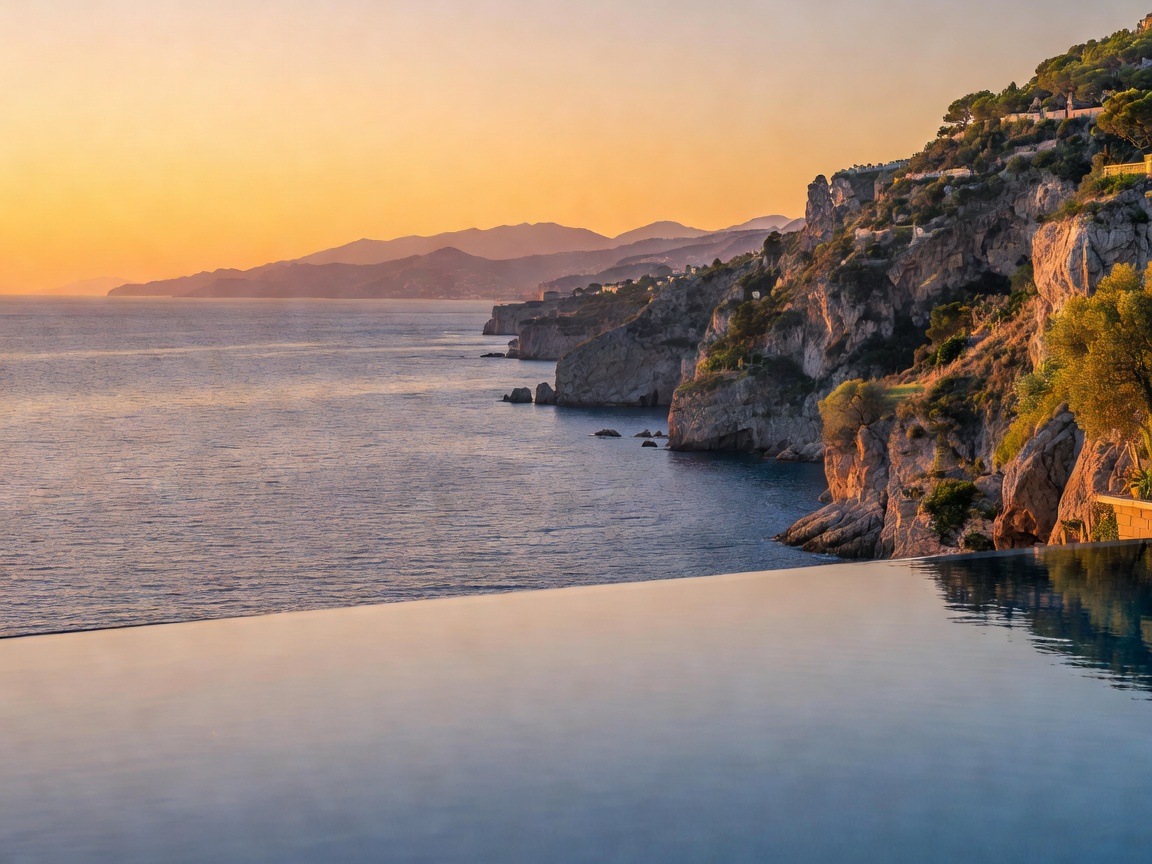
Few aquatic structures on earth command an environment quite as dizzying as the infinity pool at the Belmond Hotel Caruso. Situated at the highest peak of Ravello—an ancient town suspended well above the tourist hubbub of Amalfi and Positano—the palazzo traces its origins to the 11th century, when it was erected by a patrician Roman family fleeing regional turmoil. Today, the swimming installation represents a modern masterclass in structural masonry and visual illusion.
Hydraulic Engineering & Sightline Architecture
The pool's primary engineering feat is not merely its elevation, but how it addresses the abrupt topography of the Monte Lattari mountain spur. Rather than imposing a sharp, modernist concrete rectangle upon the property's historic terraced gardens, designers formed an organically curved ellipse that sits behind an 18th-century rose pergola.
The vanishing lip faces directly south-southeast. When swimming towards the edge, the viewer’s eye level is calibrated precisely so that the foreground ledge disappears entirely. The swimmer experiences an unencumbered panoramic sweep across lemon groves, terraced vineyards, and the craggy headlands of Minori and Maiori far beneath.
Thermal Regulation & Seasonal Operation
Due to Ravello's elevated position at 350 metres above sea level, evening temperatures and early spring winds can drop significantly lower than those recorded at sea level along Amalfi's marina. The Caruso addresses this through an automated heating grid that maintains the freshwater pool at an average of 28°C (82.4°F) throughout its operating window from April through October.
Water circulation is powered by variable-speed centrifugal pumps housed deep within subterranean vaults beneath the garden terraces. This subterranean layout dampens acoustic vibration entirely, preserving the serene mountain ambiance punctuated only by church bells from the nearby Duomo di Ravello.
Architectural Advantages
- Unmatched 360-degree panoramic vantage point across the entire Gulf of Salerno.
- Consistent thermal heating prevents chilly early-morning mountain breezes from spoiling swims.
- Subtle integration with centuries-old manicured gardens and Romanesque arches.
Considerations & Trade-offs
- Ravello lacks direct ocean access; reaching the sea requires steep staircase descents or shuttle transit.
- Poolside deck capacity is intentionally restrained, requiring peak-hour planning during summer months.
- High altitude exposes bathers to intense ultraviolet radiation and gusty mountain squalls.
Historical Precedent & Garden Setting
The hotel grounds were historically known as Palazzo d'Afflitto. Throughout the late 19th and mid-20th centuries, writers, composers, and statesmen took retreat in these cloisters. The pool itself stands at the western terminus of the historic colonnade, where original stone columns still stand, framing views toward the coast. The transition from ancient weathered limestone to the polished glass mosaic tiles inside the basin creates a dialogue between mediaeval fortification and twentieth-century leisure engineering.
Comparison: Elevated vs. Coastal Pools
When evaluating Campania's premier luxury pools, travelers generally weigh elevated vantage points against sea-level platforms. Properties like Hotel Santa Caterina offer direct access to ocean waves and saltwater buoyancy, but sacrifice the expansive geographical scope provided by Ravello. Caruso trades immediate oceanic access for meditative tranquility and an aerial perspective of coastal geography that cannot be duplicated along the shoreline.